Showing posts with label Utrecht Blue. Show all posts

Saturday, November 6, 2010

Harvesting After Frost - Coriander and Wheat

Hard frost has hit, but gardening work continues for a while longer. Compost has been spread on the garden (note to self, take frequent breaks to save the back). Leaf raking in process.

Neighbour's Mountain Ash (aka Rowan, Genus: Sorbus), not sure which species. The photos were taken during a brilliant rose-coloured sunrise. The photos are shown as-is, unedited.

Harvesting continues. The coriander (cilantro) is at perfect harvesting conditions, falling off the plant with relatively little effort (relative to the wheat harvesting).


Below is Threshing Box Experiment #1 for the wheat. Should be self-explanatory from the photos.


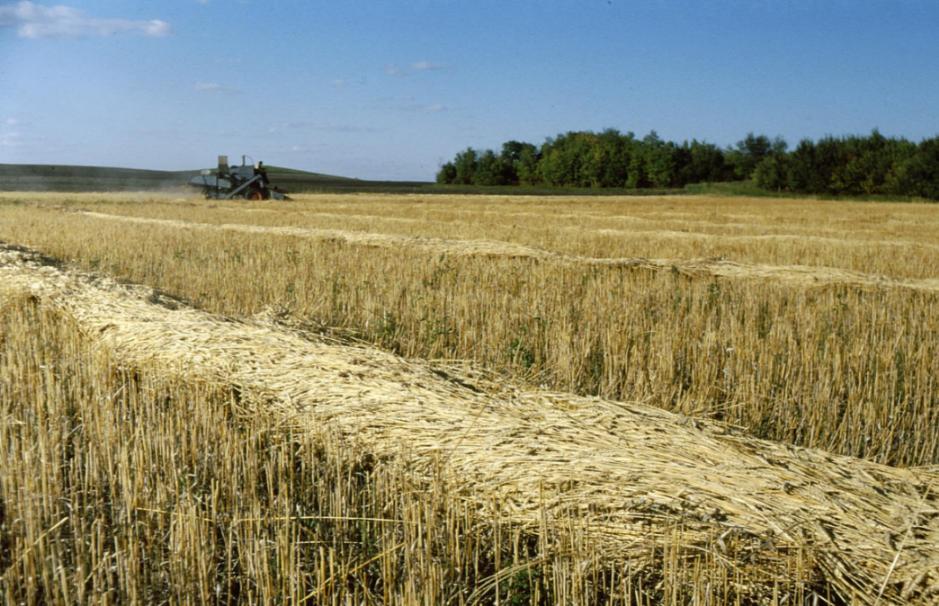
I have not got around to winnowing the grain yet. Not sure if there is really any easy way to do this. No matter what method, it is time and labour intensive at this scale. Harvesting machines rank high on the labour-savingness scale. So far my other half has been meticulously separating the hulls from the grains during the occasional movie watching.

Utrecht Blue Wheat (above) after hard frost. Quinoa behind and on the right.

Monday, August 30, 2010

August Garden Update

My neighbour called this a Himalayan Orchid but a web-search suggests it is more likely a Himalayan Balsam (Impatiens glandulifera), also known as "Policeman's Helmet". This eager volunteer plant migrated over the fence from the neighbour's yard.

Considering that it's growing in a pile of rocks, I suspect this may be a good candidate for the next revision of the undesirable Alberta invasive species list. A brief web-search confirms its invasive nature including seed pods that explode, spreading seed several meters! OK, I'm going outside to pull it right now. It has an attractive flower that belies its evil intent to take over the world.


My guess: Canadian Tiger Swallowtail (Papilio canadensis) caterpillar. Found August 21 on an apple tree leaf 2 blocks from our home. This seems late in the year to find this caterpillar, since this reference mentions "This species has only one generation per year, usually appearing in mid-May and flying to late July depending on latitude." Maybe they are trying for a second generation? Or wrong species? The Eastern Tiger Swallowtail apparently goes for 2 summer generations in the warmer eastern climates.

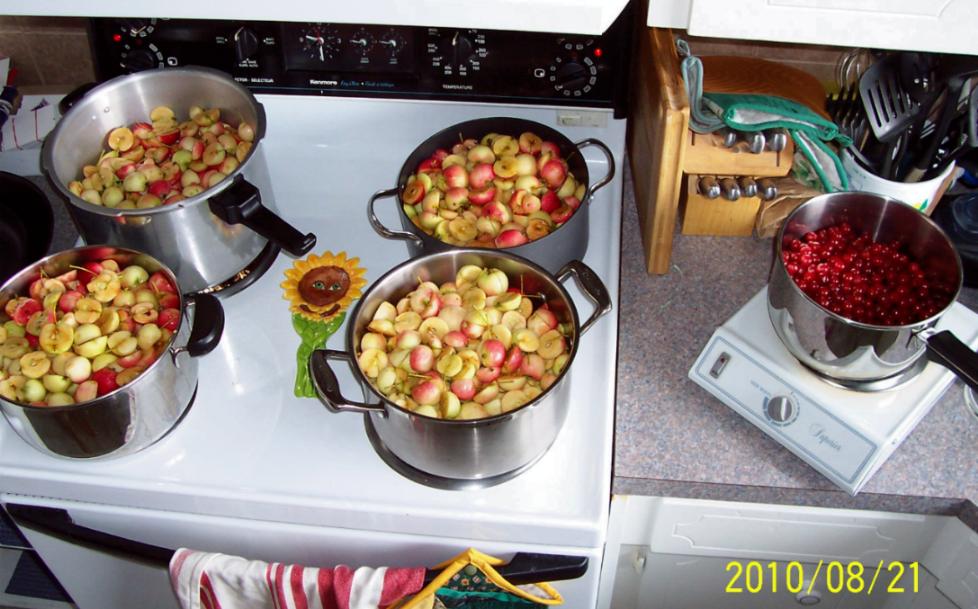
The annual Zero-Mile-Diet-Applesauce-Making-Festival gets ambitious this year. A little too ambitious for one weekend in retrospect, but it's satisfying to survey the full freezer afterwards. No canning this year, too busy with baby to take care of. Our favourite tree is about a 5 minute walk from the house. It's one of many to choose from within similar range.

This time we also picked some sort of prairie cherry (with pits) from the neighbour's yard. It looks and tastes somewhat like a Nanking Cherry. It is likely one of the fruit bushes listed on this page. The bushes had no thorns, which I thought the Nanking Cherry has, but I could be wrong.

The Utrecht Blue Wheat heads are now turning blue (though it's hard to tell due to high exposure and contrast in the photos). Due to wet conditions this summer and possibly for want of a longer growing season, the wheat is still quite green. I've started to cut it and hang it in the garage to ripen and avoid possible frost tonight.


The "West Central Garden", showing marigolds, beans, cilantro and carrots.

Bean harvest is turning out really well this year. The carrots that did germinate are doing well. We will start harvesting the potatoes soon. We have virtually no raspberries or strawberries yet; not sure if it's the variety, weather or improper care. They are not very established yet, so we will see if they improve yield next year.

Wednesday, August 4, 2010

July/August Update

Above: Unknown potato variety and Utrecht Blue Wheat. The wheat heads have begun to form but are green at this stage and not yet "blue".

Delphinium (transplanted from neighbour last year)

Amaranth R158 (Amaranthus cruentus) has decided to grow after all, though still slowly. The R158 variety is described as "developed by Johnny's Selected Seeds and Rodale Research Centre. The leaves and seed heads are mostly red. It is early and heavy yielding." The grains are rich in protein (16 - 18%). Amaranth is believed to be a domesticated form of Pigweed (Amaranthus hybridus). It was historically grown in Central America as long ago as 4000 BC [unreferenced wikipedia info, to be confirmed].

Carrot going to seed in its second year. The carrot was found in the garden this spring left behind from last year. It was transplanted to an appropriate location so we could collect the seeds.

Mystery volunteer plant/weed in compost pile.

Close-up of the mystery weed flowers.

[UPDATE: Appears likely to be Common Hemp Nettle or Galeopsis tetrahit identified by Dave the Home Bug Gardener, see comments below]

Possibly some kind of volunteer Wild Mustard (possibly Brassica kaber)? I was debating letting it go to seed and try eating the seeds, but I changed my mind and pulled it. I might try if another one pops up. I think this is the Mystery Weed posted previously.

Thursday, July 1, 2010

June Garden Update

Most plants, especially those planted directly in the garden this spring, are a week or two behind due to some cool wet weather from end of May to mid-June. But with some recent hot weather, some are picking up the pace.

Unknown variety of Potatoes (above). This is what they looked like before planted (below).

They were received from friends of family in a small town in Saskatchewan who have been growing them for years. They have no scab and looked healthy, so thought we'd give them a try.

The R158 Amaranth seems to be growing very slow most likely due to poor soil conditions. In hindsight I should have dug out some of the heavy clay and planted the seedlings in a planting soil mix within the clay. I did not spread much compost this year due to short supply (it's amazing how much the volume reduces as it digests!). This section of garden was recently overturned sod that has a high clay content and likely low soil nutrients.

The Temuco Quinoa is also growing slow, most likely due to poor soil conditions.

The amaranth and quinoa seeds are from the last Seedy Saturday exchange table. Interestly, they were left at the table by a local garden blogger, whom I asked last year about where to obtain some amaranth and quinoa seeds! There are some excellent posts on Teresa's blog on how to harvest the amaranth and quinoa seeds I plan to reference.

Approximately from bottom to top of above photo: volunteer Chervil forest, Peas, Beans, volunteer Dill, experimental bird scaring device (some seedlings have been disappearing), Potatoes...

... Dill, volunteer Carrot, Potatoes...

... Brussels Sprouts, volunteer Spinach, Utrecht Blue Wheat, Quinoa (left of wheat)...

Delphinium (left), volunteer Oregano and Strawberries (behind).

Volunteer Chervil thriving where even the dandelions hardly survive.

Volunteer Chervil "forest". Chervil has a pleasant licorice flavour.

Friday, April 9, 2010

Heirloom Wheat Varieties

At Seedy Saturday a few weeks back I bought some heirloom (heritage) open-pollinated wheat varieties for some trial plots in the garden this year. Although I grew up on a farm and have some basic knowledge of how the stuff grows, I have not attempted to grow grains on a small scale before (except some very small plots many years ago).


This will prove especially interesting when threshing time comes. Machines have been invented to thresh grains for a reason. From what I've read in the history books (and seen in developing countries), it can be a lot of work! Fortunately I've read about some methods for small scale threshing that I'll have to experiment with and that should for the most part eliminate my concerns. More on that in future postings.

Growing ancient varieties of plants seems to be a fad of late and I think a worthy cause to preserve the genetics to prevent extinction. Why? Well, if it wasn't for the efforts of some persevering souls to save some ancient kinds of wheat through the generations I would not be able to enjoy foods like pizza like I once did! The revival of Red Fife Wheat is one such inspiring example, though I have not experimented with this variety yet.

I developed a wheat intolerance a few years back after a bout with the flu. Since then I have discovered that I can tolerate spelt (Triticum spelta), an ancient variety of wheat. The science on this is not very far along yet, so the theories on why this is so are still somewhat speculative. In the meantime I plan to experiment with some other ancient wheat varieties to see what I can stomach and possibly open up new food opportunities while helping preserve and multiply some heirloom varieties.


The varieties I purchased are Utrecht Blue and Polish Wheat. The taxonomy of wheat I have since discovered is somewhat confused at this time, and clarified somewhat on this table. To simplify things I will refer to the "traditional" species names, which can be correlated to other taxonomic systems on the table linked above.

I have read that Utrecht Blue may possibly be Triticum macha but have not been able to confirm this. There seems little info about this wheat variety other than what was provided in the seed catalogue from Jim Ternier of Prairie Garden Seeds (from whom I bought the seeds at Seedy Saturday) which reads: "This variety was still grown around Utrecht, Netherlands in the early 1900's". Since my grandpa grew up in that very region this caught my eye. My ancestors likely grew and ate this same wheat variety! Prairie Garden Seeds has many other heirloom varieties I hope to try in coming years.

Triticum macha has been grouped in the more recent taxonomic systems with Triticum spelta as Hexaploid (6x), Domesticated and Hulled. My body seems to have tagged Triticum aestivum (Common bread wheat) as bad, and for some unknown reason, spelt is OK. So if Utrecht Blue is different enough from modern wheat and possibly similar to spelt, I may be able to eat it without ill effect.

Polish Wheat (Triticum polonicum) is categorized under Tetraploid (4x), Domesticated and Free-threshing along with durum wheat (used to make pasta). I plan to experiment with durum also since it is technically yet another wheat variety different from bread wheat.

One thing I am not sure about is if these two wheat's can cross-pollinate. I may have to grow only one each year over the next two years. More on this topic to come.