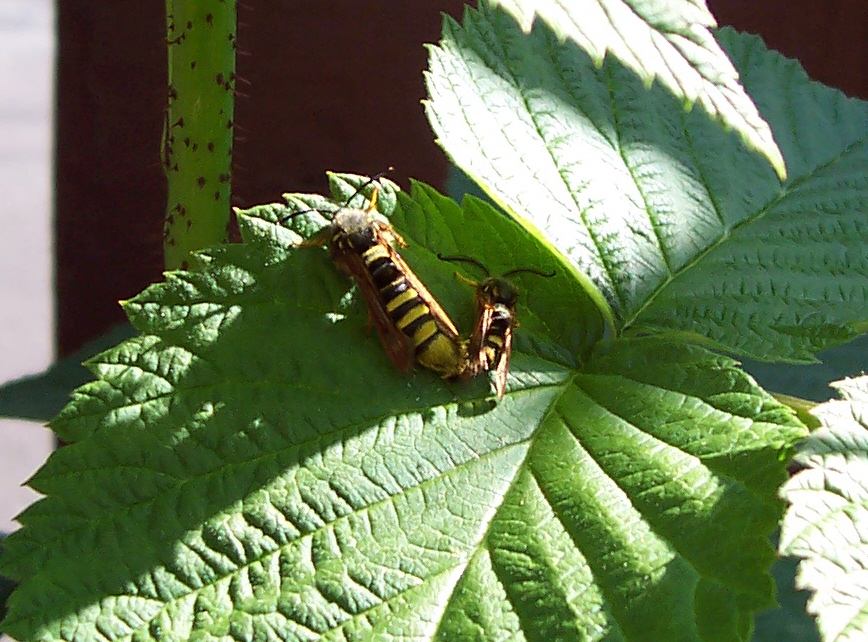
This pair of wasp look-alikes was found on a raspberry leaf in the backyard garden. First appearing to be similar to a yellow jacket, I searched online through the 18 Yellow Jacket species in Alberta (see links at bottom of page for more info), but there were no matches. The Home Bug Gardener has since come to the rescue again and provided the following information:
I think you have a pair of mating Clearwing Moths (Family Sesiidae) - most of which mimic one wasp or another.
The American Hornet Moth aka Poplar Clearwing Borer, Poplar Crown Borer: Sesia tibialis (Harris, 1839) seems most likely. The larvae burrow through the cambium of aspen, poplar, green ash, lilac and other hardwoods. I saw what I think was one in my yard a couple years ago - but she quickly flew off and I got no picture.
Pretty cool mimic, because yellowjackets even mate that way - with the male dangling from the female (although male yellowjackets are more similar in size to females).
See: http://bugguide.net/node/view/
Also: http://www.entomology.museums.
NB - species name seems to be misspelled - tibialis in my books
It is fascinating to learn about this species, which I knew nothing of before. It is easy to be fooled by wasp look-alikes.
More info from the second link above:
life history
The larvae are borers in the stems and roots of the hosts. The life-cycle requires two years to complete, with the moth overwintering twice in the larval stage. They pupate in the spring of the third year, and emerge shortly thereafter. The adults are diurnal, but are rarely seen.
diet info
The larval host is species of poplar, and to a lesser extent willows. They appear to prefer stressed of damaged host trees.
range
Widespread in western North America, east at least across the Prairie Provinces, and south to California and Arizona. In Alberta it has been collected mainly in the foothills and parklands, but likely occurs throughout the wooded parts of the province, wherever hardwoods are present. It has been recorded in adjacent Saskatchewan in both the arid Grasslands National Park area and at Uranium City.
notes
Also called the American Hornet Moth (Wong and Ives, 1988). It is rarely encountered unless baited with synthetic pheromones.
Links regarding the 18 yellow jacket wasp species in Alberta:
http://people.ucalgary.ca/~longair/vespine.html
Vespula genus:
http://www.biology.ualberta.ca/bsc/ejournal/bmc_05/key_vespula.html
Dolichovespula genus:
http://www.biology.ualberta.ca/bsc/ejournal/bmc_05/key_dolichovespula.html


 I am at a loss to even venture a guess, I'm not even sure if I can assure our concerned daughter that it doesn't bite. We have found 3 or 4 over the past few weeks, usually alone and somewhat docile but moving. Usually crawling slowly across the floor, the last guy attempted to fly but could not quite leave the ground (see action shot below).


 Posts


