Wednesday, June 15, 2016

Early Rhubarb Harvest

With the very early spring this year, I harvested 5.5 pounds of rhubarb from two plants in the first week of May! Some years the rhubarb has hardly poked above ground at this time.

It's time to divide the roots of the plants as they are starting to bolt after establishing for a few years.

Monday, August 25, 2014

Water Beetle?


My daughter saw this fellow slip out of the garage eavestrough and tumble into the back alley. It seemed to be a water beetle somewhat misplaced from its proper habitat. We put it into a bucket with water and it seemed quite at home swimming around. Any guesses on what type of beetle specifically? 


Sunday, September 8, 2013

2013 Year in Review

Highlights of the 2013 gardening year:


Hundreds of Cedar Waxwings filling a half dozen trees before the gardening season begins.

JUNE


 Flooding near Bow River in Calgary. Bad for homeowners near the river, but the rainfall was good for the garden.

AUGUST


Making juice from neighbour's "prairie cherry" trees (not sure what variety) 


 Bumper crop of raspberries. The patch is finally established. The right amount of periodic rains, soil enrichment, pruning and no hail were all factors.

 Red cabbage in foreground.

 Beans. Rhubarb division/transplant.

A tangle of herbs: Chervil, chives, sage, mint, cilantro. This unplanned companion planting (I let the annual seeds grow where they chose).

Most noteworthy was no hail this year!

Beans are now pulled, delphinium and raspberries chopped down for end of the summer.

Sunday, May 26, 2013

Mystery Flower

My mom sent these photos of a mystery flower in her garden in southern Saskatchewan. It is a perennial that someone gave it to her a few years ago, but she doesn't know what it is.  If anyone has any ideas what it might be, let me know!


It is the one with white flowers on the ends of tall stems with the leaves bunched up at the base of the plant.


Photo of the plant when young.

Saturday, September 1, 2012

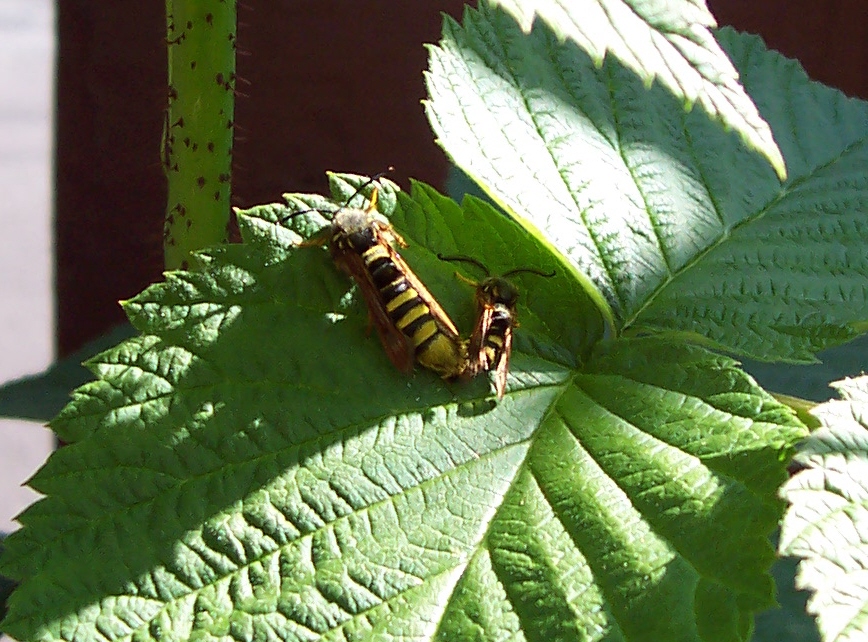
Poplar Clearwing Borer (Sesia tibialis)

This pair of wasp look-alikes was found on a raspberry leaf in the backyard garden. First appearing to be similar to a yellow jacket, I searched online through the 18 Yellow Jacket species in Alberta (see links at bottom of page for more info), but there were no matches. The Home Bug Gardener has since come to the rescue again and provided the following information:
 
I think you have a pair of mating Clearwing Moths (Family Sesiidae) - most of which mimic one wasp or another. 

The American Hornet Moth aka Poplar Clearwing Borer, Poplar Crown Borer: Sesia tibialis (Harris, 1839) seems most likely. The larvae burrow through the cambium of aspen, poplar, green ash, lilac and other hardwoods. I saw what I think was one in my yard a couple years ago - but she quickly flew off and I got no picture.

Pretty cool mimic, because yellowjackets even mate that way - with the male dangling from the female (although male yellowjackets are more similar in size to females).

See: http://bugguide.net/node/view/160324

Also: http://www.entomology.museums.ualberta.ca/searching_species_details.php?fsn=Sesia&sb=1&r=2&o=1&c=2&s=6200&sn=Sesia+tibiale

NB - species name seems to be misspelled - tibialis in my books 


It is fascinating to learn about this species, which I knew nothing of before. It is easy to be fooled by wasp look-alikes.

More info from the second link above:

life history
The larvae are borers in the stems and roots of the hosts. The life-cycle requires two years to complete, with the moth overwintering twice in the larval stage. They pupate in the spring of the third year, and emerge shortly thereafter. The adults are diurnal, but are rarely seen.

diet info
The larval host is species of poplar, and to a lesser extent willows. They appear to prefer stressed of damaged host trees.

range
Widespread in western North America, east at least across the Prairie Provinces, and south to California and Arizona. In Alberta it has been collected mainly in the foothills and parklands, but likely occurs throughout the wooded parts of the province, wherever hardwoods are present. It has been recorded in adjacent Saskatchewan in both the arid Grasslands National Park area and at Uranium City.

notes
Also called the American Hornet Moth (Wong and Ives, 1988). It is rarely encountered unless baited with synthetic pheromones.

Links regarding the 18 yellow jacket wasp species in Alberta:

http://people.ucalgary.ca/~longair/vespine.html

Vespula genus:
http://www.biology.ualberta.ca/bsc/ejournal/bmc_05/key_vespula.html

Dolichovespula genus:
http://www.biology.ualberta.ca/bsc/ejournal/bmc_05/key_dolichovespula.html

Dark Brown Fungus on Paper Birch Tree


Here is an interesting looking fungus my daughter found on our dead paper birch tree. She yelled at first as she thought it was a large bug. The fungus measures about 3 x 2 x 2 cm in size. We'll see what happens to it later in the summer. The photo was taken Aug. 16.

Sunday, August 5, 2012

Creeping Bellflower (Campanula rapunculoides)

Creeping Bellflower (Campanula rapunculoides) has arrived in our yard. Which is not surprising since down the street the plant is being encouraged in a flower bed. Hopefully they will not cause too much trouble. Thankfully it was around the lilac tree in the lawn and not the flower bed.

Note to fellow gardeners: please pull out this notourious weed and don't be tempted by NEW and exciting exotic flowers that are the potential next invasive weed for us to deal with. Focus on native or near-native species where possible.


More info:

2012 Garden Update


Rhubarb came up Apr. 22 this year, about average timing. A cubic yard of 95% peat moss and 5% steer manure was added to the garden in April, the first imported soil (and some new weed seeds) to the garden ever. A mild May got the garden off to a good start. 

After enjoying spinach and swiss chard for several weeks, the garden was hammered with marble to nickel sized hail for about 40 minutes on July 5. Fortunately the spinach was already starting to bolt and the swiss chard was being ravaged by leaf miners, so there was no major loss. The rest of the garden recovered well in the following weeks thanks to plentiful and regular rains. The zucchini really took off (see above and below before and after photos).


The green barrel above is the neighbour's rain barrel which froze and cracked. It now has a second life as a  composter after I cut the bottom off and drilled some holes. The plan is to establish some Thyme around the paving stones above.


Clockwise from top: Scattered Chervil, kale, sage, spinach, kale again, chives, chervil, thyme. 

Sage and thyme are new this year.


New garden expansion with raspberries from the neighbour. One plant's leaves looked odd, so I dug it out in case it had a virus. The rest seem OK, although some berries seem slightly deformed. We'll see if they improve after they establish better. 

 Foreground: Oregano bush and delphinium behind with hail damaged leaves.

Mint was added this year (foreground), with rhubarb and raspberries behind.
Other non-garden urban homesteading news includes successful and delicious homemade beef jerky with the new dehydrator! Best way to get the kids to eat meat and of course handy for camping.

Saturday, August 13, 2011

Monster Bee - Bumble Bee Queen


Two years ago while wandering in the garden I heard what sounded like an abnormally low and loud buzzing from a flying insect. I then watched in disbelief as a bee about 4 cm long buzzed around the flowers! Having grown up in a rural setting on the Canadian prairies, I have seen most noteworthy common insects. Never in my life have I seen a bee larger than the typical +/- 2 cm long variety. This bee was at least twice as large! Since then I have not seen a bee like this. Until today.

I managed to get a few fuzzy photos of the creature. I'm guessing this much be either a relatively new species to the Canadian prairies, or a very rare one at least. The bee is on Delphinium flowers about 3 cm in width. I estimate the bee to be about 3.5 to 4 cm in length (depending if you include wingtips).

UPDATE: Thanks to a tip from the Home Bug Gardener, the bee in the photo looks likely to be a queen bumble-bee. I later discovered my next door neighbour has a bee nest under her back step, the possible bee colony location for this queen. The bees are frequent visitors in particular to our oregano plant, where I typically see at least 10 bees feeding at any given time. However, the queen is rarely seen, this is only the second time in the last two years I've seen her.


In other news, we have been enjoying garden produce all summer, especially lettuce, spinach, volunteer lamb's quarter and chervil salads (I also include radish leaves, though the rest of the family does not care for them due to the small fuzz on them). Most plants are recovering from the hail except maybe the potatoes.

Sunday, August 7, 2011

Saskatoon and False Solomon's Seal Berries

On an urban foraging outing today I gathered some wild Saskatoons. It is a bit early as the few that were not under-ripe were barely ripe. The best picking will be in a week or two. We compared the taste with a commercial variety and find the taste much stronger (and a bit more tart) in the wild berries. I'm guessing that one wild berry contains more nutrients/anti-oxidants/etc. than a single commerical berry, even though the commercial berries are larger. The commercial berry is quite bland, watery and sweet tasting in comparison.

There was a lot of False Solomon's Seal (Maianthemum racemosum) growing among the saskatoon berries. When picking the low Saskatoon berries it could potentially be easy to accidentally pick a False Solomon's Seal. The berries look similar at this time of year on quick glance. So I did some quick online and book searching to check if it is poisonous (as I may take the kids next time). My book source [1] does not indicate edibility, but a few online sources indicated they are "edible, but no palatable" and high in Vitamin C [2], [3].

Also, "the fruit is said to be laxative in large quantities when eaten raw, especially if one is not used to eating it, though thorough cooking removes this laxative effect. Young leaves are edible, raw or cooked. The young shoots, as they emerge in spring, can be used as an asparagus substitute. The young shoots and leaves are cooked and used as greens. The root is edible cooked. It should be soaked in alkaline water first to get rid of a disagreeable taste. It can be eaten like potatoes."[3] Medicinal uses are also listed at the link.

So it appears the occasional False Solomon's Seal berry will not do much harm if not too many are eaten at once.

[1] Wildflowers Across the Prairies, Field-Use Edition, F.R. Vance, J.R. Jowsey, J.S. McLean, Western Producer Prairie Books, Saskatoon, Saskatchewan, 1977.
[2] Northern Bushcraft, list of website references, accessed August 7, 2011.
[3] Montana Plant Life , accessed August 7, 2011.

When it rains it... hails!


We usually get at least one hail storm each summer. Fortunately this year it was later in the summer than usual. Unfortunately the hail was a bit larger and longer duration than usual, plus we had two big hailstorms in three days (August 3 and 5).

Most plants have a varying degree of leaf shredding. The potatoes, lettuce (except for the ones I managed to cover with plastic during both storms), swiss chard and rhubard got the worst of it and the others faired quite well and I think will recover fine. I don't think the potatoes will grow much more this year.

Sunday, June 19, 2011

Companion Planting & June Garden Update

Something I need to learn more about is companion planting. I find in the rush of spring planting , the thought of suitable companion plants is often overlooked. However, I did manage to plant lettuce and radish together (see photo below), which I now discover in hindsight are good companion plants. Reader's Digest has a good companion planting list which confirms this.


I planted some spearmint among the raspberries and rhubarb, though these are not listed together in the above list. In hindsight, I should have planted the mint in a container to keep it from spreading. But does not appear to be germinating, which may be due to use of seed several years old.


I gambled and planted the potatoes early (above photo), first week in May, as well as several other veggies. This year we were fortunate to have the last heavy frost on April 30, well before the average last frost date of May 20. Now to see if we have a below or above average hail year...

Future posts will include a scan of the garden layout for this year. Overall the plantings are more of the same that was planted in previous years. I did not plant peas this year as they did not do so well in the last two years. Most plants are doing well except the beans, which are struggling with poor germination and insect (or bird?) nibbling.

Saturday, May 7, 2011

Rhubarb is up!

The rhubarb is up, beginning the push upward around May 5 for 2011. For comparison, previous years as follows:

2010: April 16
2009: April 25
2008: April 15

Definitely a late start this year.

Last fall I pulled out the low producing strawberries (originally transplanted from neighbour). The berries were very small (a few mm at most) and sparse. Today I transplanted some larger/higher producing strawberries from another neighbour. Nice rains this evening to help them establish. Now to figure out what all to plant this year...!

Sunday, March 20, 2011

Local Calgary Area Farms

For the most part, the garden produce from the backyard is a supplement to regular purchases from the local Co-op grocery store. However, I have been seeking alternative local sources for certain bulk purchases, mainly grain and meat.


The following is intended as a mostly personal reference summarizing local Calgary area farms that sell produce through non-retail outlets such as direct to consumers and Community Supported Agriculture (CSA's). I will include links to Farmer's Markets in Calgary, but not include individual links to the farms at the markets as they are likely already listed online.

Community Supported Agriculture

A comprehensive list can be found at the following link:

Community Supported Agriculture in Alberta

Some of the farms include:

Oxyoke Farms (near Linden, AB)

Thompson Small Farm (near Sundre, AB as of MAR 2011, formerly near Carbon, AB)


Organic Grain Suppliers

Local Organic Spelt Growers - Page with additional links specifically related to Spelt Growers

Organic Agriculture Websites - links from the Alberta Government


Calgary Farmer's Markets

A list of local farmers markets can be found at (needs updating):

Calgary Farmers Markets

Another list of Calgary and area farmers markets, may be outdated plus has annoying pop-up ads:

Calgary & Area Farmers' Markets

Below: Some Calgary Farmers Markets near north Calgary with websites:

Blackfoot Farmers Market

Calgary Farmers' Market

Kingsland Farmers' Market

Usually has some local Hutterites selling veggies in the parking lot in July and August.

This page is intended mainly for my own reference and will not be comprehensive. My interest is primarily ordering cuts of meat and organic grains directly from farmers, so that is the focus of the list. I will update it from time to time. Let me know if you see any errors or have discovered a farm that should be added.

Saturday, January 15, 2011

Black Henbane (Hyoscyamus niger) - Alberta Invasive Species Series

Catching up on some contemplated summer posts that never materialized, the following describes my encounter last summer with the intimidating (cue scary music): BLACK HENBANE (Hyoscyamus niger), also known as Stinking Nightshade . Both names sounding quite ominous. And for good reason.


I encountered a patch of these evildoers in West Nose Creek Park. Not knowing what they were at the time, I took some photos and did some research. The plants were hard to miss, standing up to four feet tall!

As someone who grew up on the prairies and never having seen this plant before, I figured such a large and obtrusive plant must be an invasive species. This narrowed my search considerably. Once identifying the plant, I washed my hands after learning of its toxic nature.

Black Henbane is classified as "Noxious" by the Alberta Invasive Plants Council [1]. Some interesting characteristics of the plant are summarized below (from [1]):
  • Annual or Perennial
  • Reproduces by seed only (see photos below of seed pods)
  • Native to Eurasia
  • All parts of the plant are poisonous to animals (including humans)
  • A single plant can produce up to 500,000 seeds per season
  • Seeds are typically viable for up to four years
  • Prefers sunny areas
Proliferate Seed Pods (above)

West Nose Creek Park (natural area), above

I notified the City of Calgary about the weeds presence and offered my volunteer labour to help remove them. Being such a large bushy plant, I envisioned that hand removal would be quite easy with a pair of rubber gloves and garbage bags. But then what to do with the remains to prevent further spread?

I received no response from the City, but a few weeks later the plants had been removed and the City had done some spot spraying for invasive weeds, primarily Yellow Clematis (Clematis tangutica) which has really taken hold in the park. I'll be keeping my eye out for their potential return.

[1] Black Henbane - Alberta Invasive Plants Council

Saturday, November 27, 2010

Local Organic Spelt Growers

I am researching options for purchasing local organic spelt. My gut reacts strongly to consumption of regular wheat, but I have discovered spelt has no such ill effects.

So far we have been purchasing organic spelt from the Daybreak-Scheresky Mill in Estevan, Saskatchewan (via a health food store in a small Saskatchewan town where the in-laws live). I have been wondering what other options may be out there and cost comparisons, since we use a lot of it. If anyone has info further to what is listed here, please let us know.

I contacted a local Calgary bakery and they said they source most of their spelt from Saskatchewan and Manitoba.

Other sources I have found, so far, via the internet includes:

Grainworks Inc. (Kincaid, SK)
A family farm moved in 2001 from near Vulcan, AB to SW Saskatchewan (near hamlet of Kincaid). They sell various organic products including spelt.

Gold Forest Grains (near Edmonton, AB)
Do not currently grow spelt, but plan to in the near future.

General Directories of Organic Farms

Saskatchewan and Alberta Organic Farm Directory (no spelt growers currently listed)

Calgary Area Organic Crop Growers Directory (no spelt growers currently listed)

Alberta Virtual Farm Tour (no spelt growers currently listed)

This page will be updated as I discover more related info.

Above photos are of the family farm I grew up on in Saskatchewan.

Saturday, November 6, 2010

Harvesting After Frost - Coriander and Wheat

Hard frost has hit, but gardening work continues for a while longer. Compost has been spread on the garden (note to self, take frequent breaks to save the back). Leaf raking in process.

Neighbour's Mountain Ash (aka Rowan, Genus: Sorbus), not sure which species. The photos were taken during a brilliant rose-coloured sunrise. The photos are shown as-is, unedited.

Harvesting continues. The coriander (cilantro) is at perfect harvesting conditions, falling off the plant with relatively little effort (relative to the wheat harvesting).


Below is Threshing Box Experiment #1 for the wheat. Should be self-explanatory from the photos.


I have not got around to winnowing the grain yet. Not sure if there is really any easy way to do this. No matter what method, it is time and labour intensive at this scale. Harvesting machines rank high on the labour-savingness scale. So far my other half has been meticulously separating the hulls from the grains during the occasional movie watching.

Utrecht Blue Wheat (above) after hard frost. Quinoa behind and on the right.